


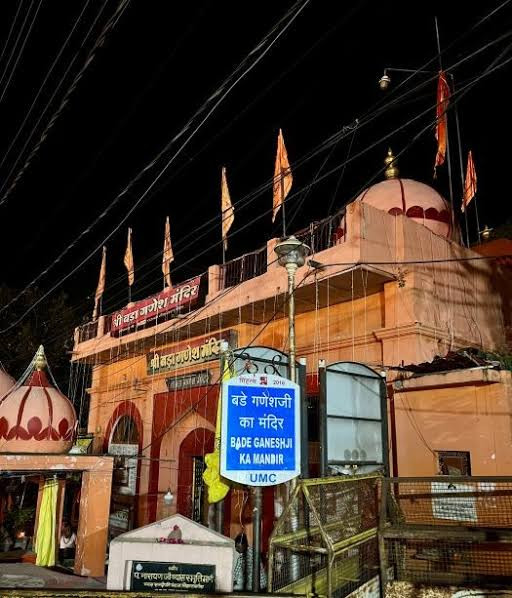
Shree Bade Ganesh Mandir
Temple History
- The Founder: The temple was established around 1901–1902 by Pt. Narayan Ji Vyas, a renowned scholar and astrologer of Ujjain, after he saw this massive form of Lord Ganesha in a dream.
- Unique Materials: The idol was crafted without any cement. Instead, a traditional mix of jaggery (gud), fenugreek seeds (methi), lime, sand, and bricks was used. It took two and a half years to complete.
- Sacred Elements: The core contains holy soil from the 7 Mokshapuris (the seven sacred salvation cities of India: Ayodhya, Mathura, Haridwar, Kashi, Kanchi, Ujjain, and Dwarka) and water from major holy rivers.
- Center of Education: Since its inception, the temple complex has also served as a traditional school (gurukul) for studying Sanskrit and Vedic astrology.
Temple Significance
The spiritual and cultural significance of Shree Bada Ganesh Mandir lies in its unique planetary positioning, rare iconography, and distinct ritual traditions:
- The Protector of Ujjain (Vighnaharta): According to local belief, because this massive Ganesha sits right next to the exit of the Mahakaleshwar Jyotirlinga, He acts as the ultimate obstacle remover (Vighnaharta) who seals and blesses the prayers of devotees leaving the Mahakal temple.
- Astrological Power (Navgrah Dosh Nivaran): Since the temple was founded by a master astrologer, it is highly revered for mitigating negative planetary influences. Worshipping here is believed to pacify malefic effects of Rahu, Ketu, and Saturn (Shani), making it a major hub for astrological remedies.
- The Unique Wish-Fulfilling Swastika: A famous local tradition exists where devotees who have a deep, unfulfilled wish go to the back wall of the sanctum and draw an upside-down (ulta) Swastika. Once their wish is granted, they return to the temple to draw a proper, right-side-up Swastika as a token of gratitude.
- The Rare Panchmukhi Hanuman Connection: The temple complex houses a rare, 100-year-old five-faced (Panchmukhi) Hanuman idol. Facing Ganesha, this shrine represents a rare convergence of intellect (Buddhi) and immense strength (Shakti), drawing massive crowds of devotees on Tuesdays and Saturdays.
Description
- The Main Deity: Features a colossal, vibrant orange, sitting idol of Lord Ganesha standing over 18 feet tall. The deity is heavily adorned with fine silver foil (vark), large expressive eyes, a prominent crown, and a trunk gracefully turned to the left.
- The Structure: A bright saffron and white double-story complex. The ground floor houses the spacious, marble-pillared sanctum (Garbhagriha), while the upper floor operates as a traditional Vedic school (Gurukul).
- The Twin Shrines: Inside the same hall sit a rare, centuries-old Panchmukhi (five-faced) Hanuman idol and a unique Shivling surrounded by 11 miniature Jyotirlingas.
- The Wish Wall: The back wall of the inner sanctum is visibly covered with hundreds of small upside-down Swastikas drawn by devotees making wishes.
Temple Timings
Shree Bade Ganesh Mandir Morning Opening Time
06:00 AM
Shree Bade Ganesh Mandir Evening Opening Time
10:00 AM
Shree Bade Ganesh Mandir Morning Arti Time
07:30 AM
Shree Bade Ganesh Mandir Evening Arti Time
08:00 AM